Welcome to my world. Jump in and get to know me.
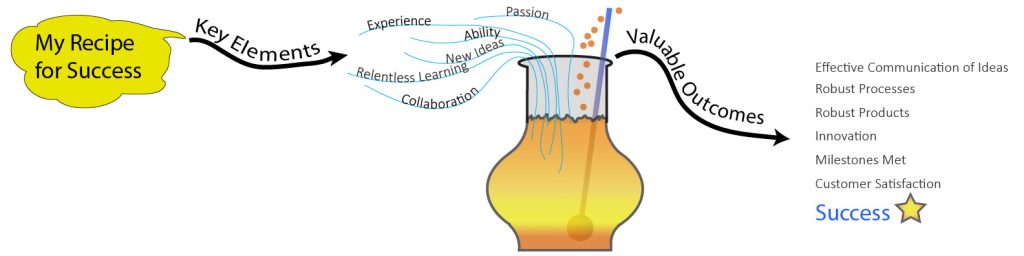
I focus on understanding my customer. It is only then that I can bring them value.
-Leland Stoe
adobe creative suite projects
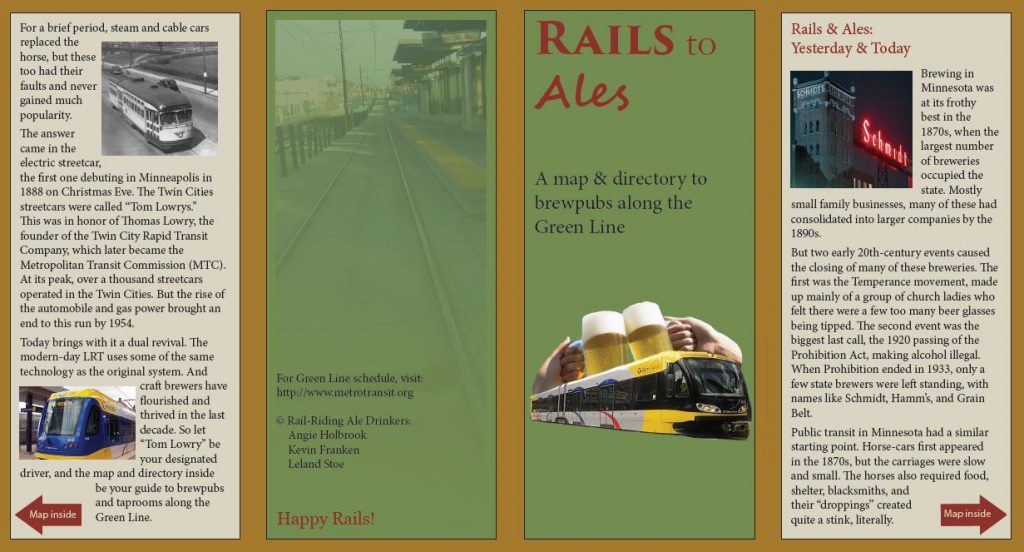
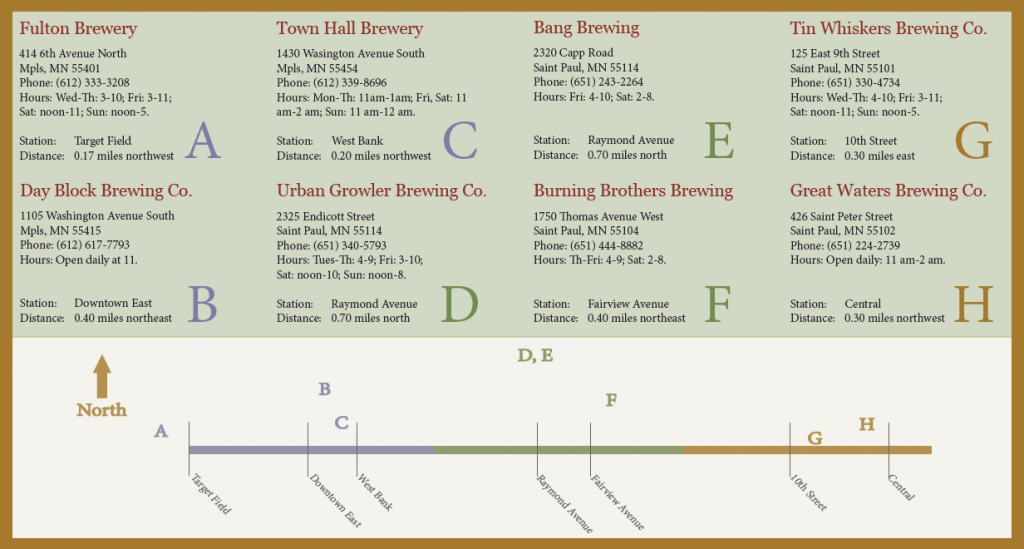
Rails to Ales brochure
Two-sided pocket brochure catering to an audience of brewhouse enthusiasts
Eat like a wildman (placard)
Two-sided placard serving to market the book

website usability test
This report describes the website usability study of <http://www.bbonline.com>. This bed-and-breakfast (B & B) website focuses on helping targeted users identify, locate and browse bed and breakfasts across the United States and internationally.
The study was conducted by Leland Stoe from November 9th through November 14th, 2015. Its goal was to gather and analyze user-experience data to identify areas where the BBOnline website could improve its user experience.
The target user population for this study was identified through scripted phone interviews. The interview results were subsequently integrated into a single fictitious persona named “Gloria.” Target users in this study were primarily middle-aged women with average to above average computer skills. None of these women had experience with <http://www.bbonline.com>.
Based upon “Gloria’s” needs and opinions, six important task scenarios were identified. Cognitive walkthroughs of these six task scenarios were conducted while using BBOnline through the lens of “Gloria.” The walkthroughs identified specific areas of focus for follow-on testing involving real users.
Task scenarios:
- You and your significant other are planning a weekend getaway. Find B & B’ s in Red Wing, MN and compare to others in the area.
- Find the Ellery House B & B in Duluth, MN by name and compare to others in the area.
- Find a list of local activities for the Ellery House in Duluth, MN.
- Browse the photo gallery for the Stone Boat Farm Bed & Breakfast in Jamaica, VT.
- Read the online reviews for Xanadu Island Bed & Breakfast and Resort, Battle Lake, Minnesota.
- Watch video of the B & B in Barbados.
Seven real users were selected through a scripted phone-screening process. Each of these users then tested the scenarios, thinking out loud as they attempted to complete each task. Data was collected and analyzed to determine whether it correlated to the cognitive-walkthrough findings and whether it revealed areas for website improvement.
Usability test data included measured parameters, such as time on task, and subjective data, such as the level of user enjoyment. Objective data was measured, while subjective data was gathered through post-task surveys, observed body language and verbal feedback from the users.
The study identified several areas of strength, as well as areas for improvement. For example, while users typically found B & B’ s easily, almost none of the users used the breadcrumb navigation to track back to find nearby B & B’s. It appeared that the users did not notice the breadcrumbs, because they were rather nondescript. Breadcrumb navigation would have improved users’ search efficiency significantly, likely leading to increased satisfaction. Another key finding involved inconsistent and misleading search functionality. Here, the search results for “Red Wing” can return either 92 results or just two results.
Additional findings include insufficient photo galleries, broken links, unhelpful maps, non-hyperlinked activities lists, hard-to-read B & B reviews, and a sign-in requirement to watch a video.
Recommendations for site improvement include standardization of search-results, making breadcrumbs appear more prominent, growing the photo galleries, creating hyperlinks to activities, repairing broken links, adding white space to B & B reviews and removing the sign-in requirement for videos
eLEARNING MODULE DESIGN
This training teaches the ANALYZE phase of the ADDIE instructional-design model. It targets service-center manufacturing engineers, laying the groundwork for these engineers to develop instructional-design plans for an eLearning module of their own. The intent is that service-center engineers will teach the PDF markup standard work to engineering colleagues on the OEM side. This should free up service-center engineers for other critical projects.
WRITING
Insights from an intentional writer-editor

The word passion immediately comes to mind when listening to Chris Hayes describe his writing and editing. It is unmistakable. During a recent one-on-one interview, Hayes reflected on his writing and editing career, and indeed his life. He graciously shared valuable insights for fellow writers and editors. His guiding words transcend the age or career length of the listener. His career path includes insightful writing and editing that point to a bright future.
Hayes currently serves as writing and research coordinator at Dakota County Technical College (DCTC). His daily routine involves extensive research that often includes interviews. He then builds a story around what he has learned. His directive is to write, as he puts it “anything for institutional advancement.”
Hayes’ intent is to write pieces that paint DCTC in a favorable light. After all, his number one target demographic is that of prospective students. Nevertheless, Hayes stays mindful of his second target audience, DCTC’s current student body. In either case, he strives to build good will by fostering positive public relations within the campus community through his work. Hayes’ authoring of articles for DCTC’s Real magazine, along with his editing of grants and proposals, helps him accomplish his mission of capturing and retaining students on behalf of DCTC.
Hayes returned to college in 2001 after working as a boiler operator for 25 years at a local florist. Since earning his bachelor’s degree at the University of Minnesota in 2003, his responsibilities at DCTC have included grants & sustainability coordinator and communications coordinator. At times, he has written anonymously for the former president of DCTC, adding to the broad nature of his writing career. His interest in writing was already percolating by second grade. Hayes remembers how his friend’s parent recognized his innate writing ability and bought a lot of paper for him. Since then, Hayes has learned much about his art and has identified several key traits of talented writers and editors.
For instance, he believes that writing is hard work, comparing it to weightlifting, where one’s ability increases with practice. In addition, he stresses the importance of writer engagement with the audience, singling out disengaged writers who “ … take what’s in their heads and assume others will understand.” Furthermore, he notes that good editors recognize disengaged writing containing underdeveloped support. However, Hayes cautions that good editors must strive to maintain the voice of the writer and not over edit. He acknowledges the sometimes delicate power balance between writer and editor. Hayes considers the Internet a great research tool, and says that Wikipedia is a good jumping off point. Finally, he warns that competent writers and editors, even at the Ph.D. level, must avoid plagiarism.
Tying his career to his personal life, Hayes makes key observations about himself. To begin with, though he has managed others in the past he says he prefers to focus on writing and editing because he found himself super-busy as a manager. Appearing free-spirited, Hayes describes his desire for control over what he writes. He values autonomy and views corporations as having control over the writer’s content.
As with his free-spirited view on writing autonomy, Hayes also values autonomy in editing. He says, “Ghost writing is the ultimate editing, because the editor has total control. The editor is the one putting it down. The prompt is often ‘I need an article on this’.”
Hayes prefers the role of writer while at the same time acknowledging that all writers must be editors.
When asked about his most egregious error he responds, “I’ve been pretty lucky at work.” However, he remembers an instance early in his writing career when he was “ … not meticulous.” He had submitted a query letter, a work submitted to catch the attention of an agent; however, he misspelled Vietnam. “The incident,” says Hayes, “is still stuck in my mind.”
Hayes has found writing inspiration in many aspects of his life, including his month-long visit to India, where in 2001, he attended the Maha Kumbh Mela. This massive, spiritual event is widely recognized as the largest peaceful gathering of people on Earth. According to Hayes, this event occurs just once every 120 years. Millions of people make the pilgrimage to bathe in sacred river water. Though he has not written directly about his trip to the Maha Kumbh Mela, it has provided life perspective and characters for use in his novels.
“I just like writing,” says Hayes. “I chose to study English because I was good at it.” However, he feels that having an English degree is not necessarily practical. The problem is one of experience. He laughs and says, “Do you want fries with those Wordsworth? Even those holding Ph.D.’s may not have experience.” He highlights the importance of obtaining experience to better one’s chances of landing a meaningful job.“
Hayes declines to cite any particularly memorable anecdotes, but provides a hint in saying, “Some big projects, though fun, can be frustrating for editors because of lack of attention to detail.”
Hayes’ hobbies fuel his writing passion. He tells how he enjoys weaving his outside interests into the fabric of his writing. In his latest novel, for instance, the main character is a martial artist who brings his dog everywhere he goes. This is not surprising, knowing that Hayes is a black belt in taekwondo and is a dog agility handler. In addition to these hobbies, Hayes also enjoys photography, finding it satisfying to take photos to accompany his stories.
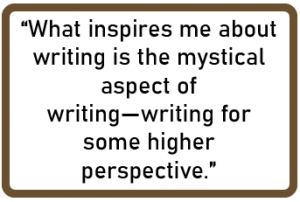
When asked what really makes him tick, Hayes replies, “What inspires me about writing is the mystical aspect of writing—writing for some higher perspective.” Specifically, he is referring to Jnana, or “the path to knowledge.”
As for his future, Hayes is not afraid to dream big. His 10-year vision for himself is that of full-time novelist in the genre of Adventure Modern Fantasy. According to Hayes, this genre contains elements of occult-horror. Judging by his current novel’s plotline, he is likely to succeed. The novel’s main character hunts assassins—and their employers—taking the job of bodyguard to a higher level, all while bringing his dog everywhere he goes.
Hayes sums up his writing and editing philosophy aptly in saying, “The story has to have some higher meaning than ‘just the story’.” As long as he remains true to his words, it appears that he is destined for success.